In our previous news article, we looked into the beginnings of First Thursday Club, our webinar series that started in 2020 to promote and support a high standard of ecology, environment and sustainability practices across the industry.
To celebrate the six-year anniversary, here is a further look at some of our highlights from the series so far, encompassing many different areas of ecology, and focusing on important topics have been dissected thoroughly by our experts.
Group dynamics – August 2023
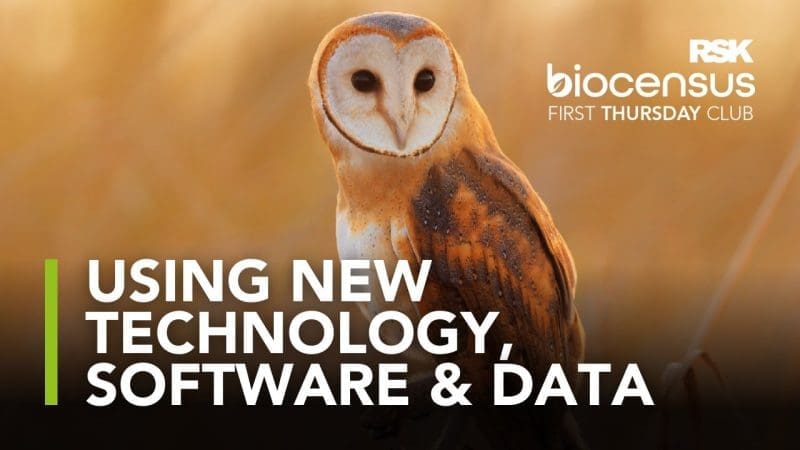
This webinar was the very first time that we have had a larger group of experts presenting the webinar – ‘Discover the Latest Technologies for Ecology Surveys’. The panel was composed of colleagues from RSK Biocensus and fellow RSK Group business, Binnies.
From RSK Biocensus was Richard Howe, former Associate Director and Digital Data and Systems Lead, now the head of RSK Digital & Geospatial Services (DGS), alongside Richard Jameson, formerly a Senior GIS Consultant at RSK Biocensus, who has joined his colleague at DGS.
Representing Binnies on the panel were Tom Wingrave, Principal GIS Consultant, Jon Goodrick, formerly a Principal Ecologist and now Associate Director, and Adele Harrison, Principal Ecologist and now also Digital Ecology Lead at Binnies.
Tom began the discussion by talking about Esri’s field applications, including ArcGIS Survey123, ArcGIS Field Maps, ArcGIS Quick Capture, and ArcGIS Workforce, all of which are apps that provide invaluable tools for ecology data collection and mapping. Richard Howe followed this up with more detail about the use of ArcGIS Field Maps in Bird Surveys.
The team then spoke about many of the technologies that are being used today in ecology – including night vision aids, bat recording and movement tracking – describing what technology can do for us as an ecological consultancy, and how we can embrace this alongside our current techniques to streamline and improve the work that we do. You can watch the full video here.
With great power comes great responsibility – May 2024
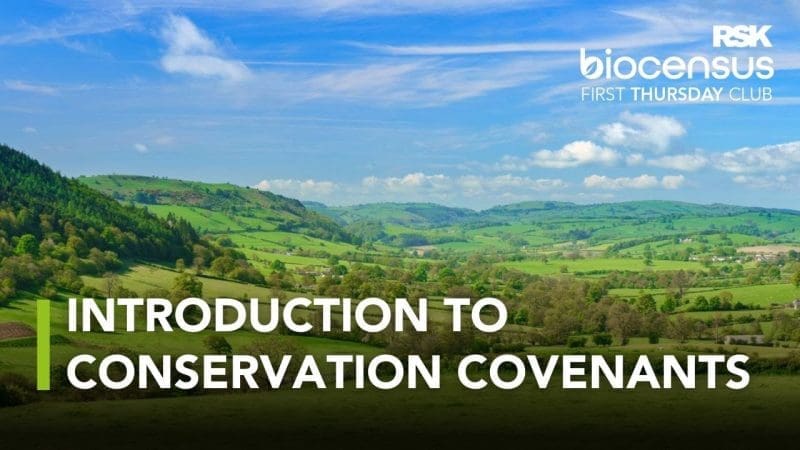
In 2024, RSK Biocensus became a Responsible Body, helping landowners, developers and partnerships realise their conservation and nature-related goals in a manner that respects and enhances the natural environment.
As the driving force behind our role as a Responsible Body, our RSK Wilding team hosted the webinar – ‘Conservation covenants and responsible bodies: what they mean for landowners’ – to discuss what our new status means, and what we can do.
Dr. Tim Graham, Director and now Lead of the RSK Wilding team co-presented with Natalie Bryce, Senior Legal Advisor for RSK Wilding. They explained biodiversity net gain (BNG) and the role of the Responsible Body, as well as observing comparisons between section 106 agreements and conservation covenants. Tim and Natalie also discussed the approach taken and processes followed by RSK Wilding as they carry out their Responsible Body duties. You can watch the full video here.
First Thursday Shrub – February 2025
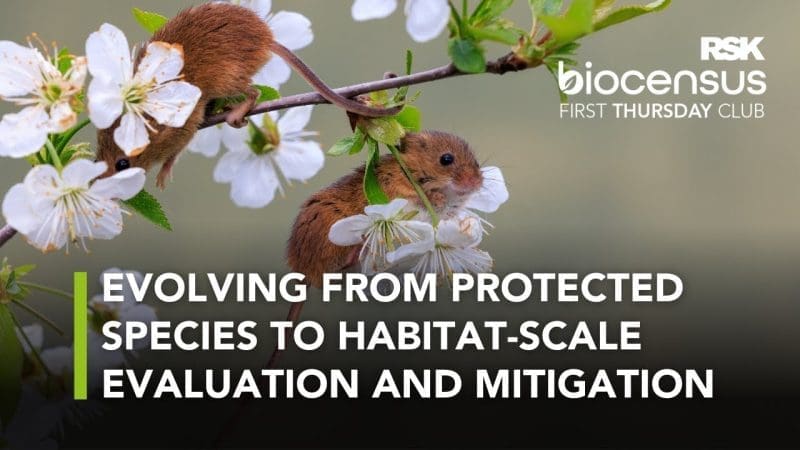
‘Why Botany Matters: The Crucial Role of Botanical Skills’ – gave a deep dive into the ferntastic world of botany, hosted by our in-house experts Sarah Harmer and Dr. Richard Carter, both Directors at RSK Biocensus.
The webinar began with a broad overview of what botany is. This was followed by a discussion of the regulatory framework that applies to this area of ecology, which includes the Environmental Improvement Plan (EIP23) and the State of Nature report (2023), looking into what these mean to botanists now, and what we are looking to achieve in the future.
The team then took an insightful look into the skills a good botanist needs, dividing these into species, habitat, community, function & significance, and management & creation.
The webinar was a fascinating look into all things botany, as well as the upcoming changes to the National Planning Policy Framework. You can watch the full video here.
Protecting People and the Planet – September 2025
This next webinar was a co-production between RSK Biocensus and Nature Positive, as we question how the push for sustainable infrastructure can uphold human rights.
‘Why human rights matter to construction and infrastructure, and how ecologists can protect them’ – was hosted by Emily Lee, Head of Human Rights for Nature Positive and RSK Group, who was joined by her colleague Euan Chan, Senior Human Rights Consultant.
Having first described their roles with Nature Positive, the pair then went on to discuss the key foundations of human rights as a whole, and how the Sustainable Development Goals (SDGs) show that human rights are not separate from sustainability – they underpin it. This included detail on the ways that construction can have an increased impact on people’s rights to health, food, clean water, culture, livelihoods, and life itself. They looked into the sources of impact, and the consequences for both people and the environment.
Emily & Euan then talked about how construction and ecology professionals can help to protect human rights, by sourcing responsibly, staying vigilant and championing participation, before explaining why this matters for construction professionals and business as a whole. You can watch the full video here.
The Planning and Infrastructure Bill – February 2026
‘Planning and Infrastructure Bill: The final text and what’s next’ – provided a comprehensive overview of Part 3 of the Planning and Infrastructure Bill.
Alexa Culver, Legal Counsel for RSK Biocensus and part of the RSK Wilding team, gave a critical insight for developers, ecologists, land managers, planners, local government officers and environmental consultants involved in projects across England.
Alexa gave an overview of the bill itself, and the changes that it makes with new environmental delivery plans, as well as the differences between the draft bill and the final text.
The webinar then moved onto the implications of the new bill for developers, planning authorities and the environment. This was a vital look into how we as ecologists, as well as the world around us, will be affected by this new bill. You can watch the full video here.
An Important Collaboration – June 2026
RSK Biocensus and Mammal Society, with whom we have had a close relationship over the years, jointly presented the next webinar; ‘Under-represented Groups in Ecology Professions’, which focussed on exploring ethnic and racial diversity, or the lack of it, within the ecology sector.
Five speakers worked together to discuss these issues, featuring Alan Yap, Consultant Ecologist at RSK Biocensus, alongside Ferozah Mahmood, Engagement Officer from the Surrey Wildlife Trust, Abby Onencan, Associate Director within the School of Environmental Science, Emma Onyejekwe, a registered veterinary nurse who is looking to move into wildlife conservation, and Yashni Vithlani, Training and Events Intern for the Mammal Society.
The panel, who are at various stages of their careers, described their personal experiences of working in ecology and conservation, the challenges they faced when beginning their careers in the field, and their perspectives on what needs to change to improve ethnic and racial diversity across the ecology professions.
You can watch the full video here.
Pretty Fly for a Bug Guy – September 2026
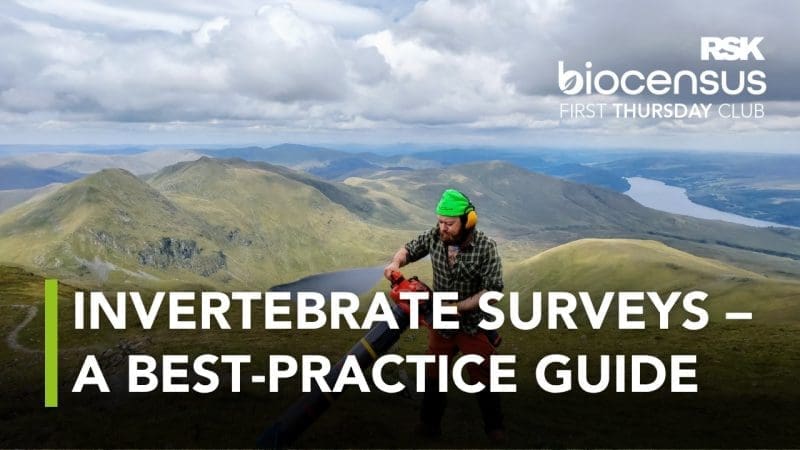
Our most recent edition of the series – ‘Consideration of Terrestrial Invertebrates in Ecology Projects’ – considers terrestrial invertebrates in ecology projects – covering when these surveys are needed, how to commission them and what methods to use.
Providing this essential viewing was Chris Cathrine, Technical Director at RSK Biocensus and bug fanatic. Invertebrates are a major component of terrestrial ecology (for example, they represent 98% of all known species in Scotland) and are the foundation of most ecosystem services, yet are often overlooked by professional ecologists. The webinar looks into why this might be and why they should not be.
Chris began by looking into the different types of invertebrates including butterflies, spiders and beetles before discussing why invertebrates are so important to our ecosystem. From pollination and soil creation, to pest control and being food for other animals, invertebrates are essential to our world as we know it.
Chris’s expertise was on clear display throughout the webinar, as he gave a thorough look into terrestrial invertebrates as a whole, how they affect us and most importantly, how do we protect them? You can watch the full video here.
Conclusions and the Future
After six years, 65 webinars and counting, featuring over 60 experts discussing vital topics and sharing their passions, the First Thursday Club series has continued to go from strength to strength.
Next month, Mark Lang and Ed Nicholson will be looking into how solar projects can turn ecological plans into reality. You can register to attend the new webinar – ‘Multi-use solar: Planning to deliver energy, biodiversity and productive farmland’ – by clicking here.
If you want to look deeper into the history of the series, you can find the full collection of First Thursday Club videos on the RSK Group YouTube channel.